

Electrical problems rarely show up out of nowhere. Most start small — a breaker that trips more often than it used to, a panel that runs a little warmer than it should, a light fixture that flickers before it fails outright. Catch those signs early and a fix is usually quick and inexpensive. Miss them, and they tend to turn into bigger repairs, unplanned downtime, or worse.
That’s the case for commercial electrical maintenance: staying ahead of problems costs a lot less than reacting to them. At Postma Electric, we work with businesses across Central Alberta on both sides of that equation — the one-off repairs that come up day to day, and the longer-term preventive electrical maintenance programs that catch issues before they become emergencies.
What Is Short-Term Electrical Maintenance?
Short-term maintenance is the reactive side of the job — fixing what’s already broken or addressing an issue as soon as it’s identified. A breaker that keeps tripping, an outlet that’s stopped working, a fixture that needs replacing, a panel that’s showing signs of wear. This kind of work matters, and it always will, but it’s fundamentally about responding to problems after they’ve already started.
Relying on short-term maintenance alone has a downside: by the time something fails enough to notice, it’s often already affected operations, and sometimes it takes other equipment or systems down with it.
What Is Long-Term Preventive Maintenance?
Long-term building electrical maintenance takes the opposite approach — scheduled inspections and testing designed to catch problems while they’re still minor, before they turn into failures or safety hazards.
An ongoing program typically means regular facility inspections, testing on a set schedule, and monitoring how a building’s electrical systems perform over time. Instead of waiting for something to break, we’re looking for the early signs that something’s heading that way — and dealing with it on our terms, not on the equipment’s.
Benefits of Ongoing Maintenance Programs
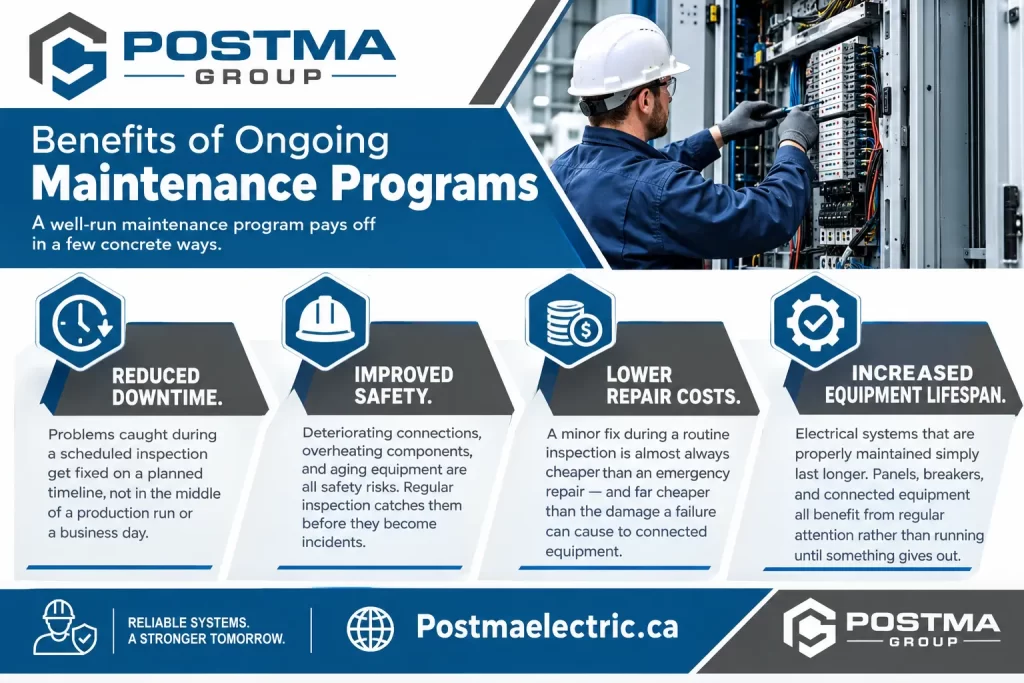 A well-run maintenance program pays off in a few concrete ways.
Reduced downtime. Problems caught during a scheduled inspection get fixed on a planned timeline, not in the middle of a production run or a business day.
Improved safety. Deteriorating connections, overheating components, and aging equipment are all safety risks. Regular inspection catches them before they become incidents.
Lower repair costs. A minor fix during a routine inspection is almost always cheaper than an emergency repair — and far cheaper than the damage a failure can cause to connected equipment.
Increased equipment lifespan. Electrical systems that are properly maintained simply last longer. Panels, breakers, and connected equipment all benefit from regular attention rather than running until something gives out.
Common Maintenance Services
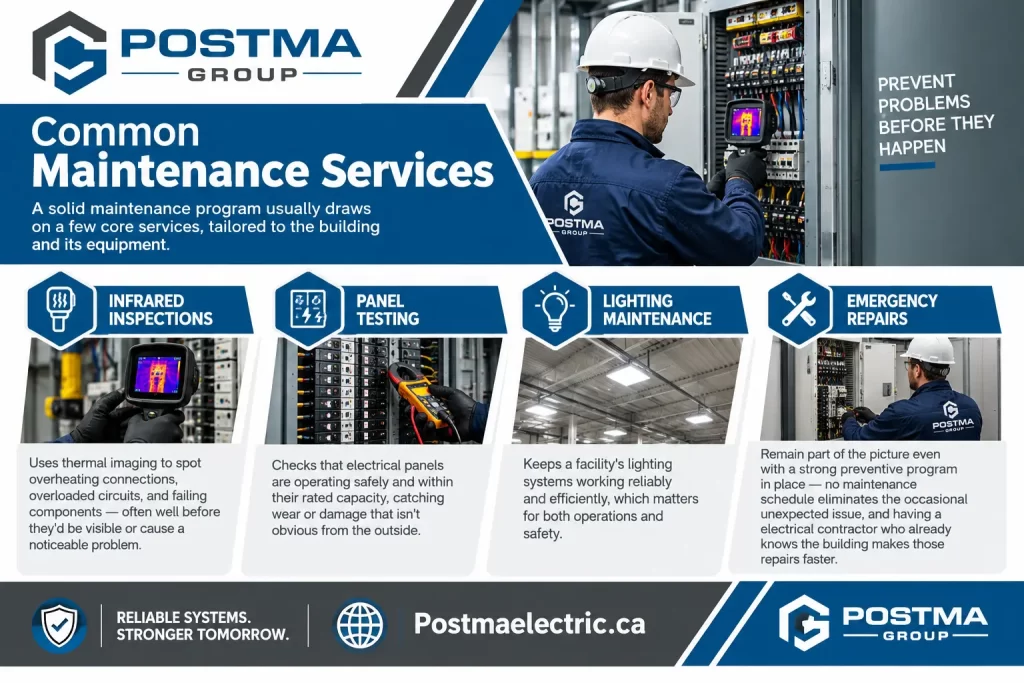 A solid maintenance program usually draws on a few core services, tailored to the building and its equipment.
Infrared inspections use thermal imaging to spot overheating connections, overloaded circuits, and failing components — often well before they’d be visible or cause a noticeable problem.
Panel testing checks that electrical panels are operating safely and within their rated capacity, catching wear or damage that isn’t obvious from the outside.
Lighting maintenance keeps a facility’s lighting systems working reliably and efficiently, which matters for both operations and safety.
Emergency repairs remain part of the picture even with a strong preventive program in place — no maintenance schedule eliminates the occasional unexpected issue, and having a electrical contractor who already knows the building makes those repairs faster.
Creating a Maintenance Plan for Your Facility
Every building is different, so a maintenance plan should be built around the specific facility — its age, its equipment, how it’s used, and what’s most critical to keep running.
We typically start with a full assessment of the existing electrical infrastructure, then build a maintenance schedule around what we find: how often inspections should happen, which systems need the closest attention, and where an electrical service contract makes sense for ongoing coverage rather than one-off calls.
The right plan balances cost against risk — not every system needs the same level of attention, but the systems that matter most to your operation shouldn’t be left to chance.
Electrical maintenance isn’t the most visible part of running a facility, but it’s one of the most effective ways to protect the investment you’ve already made in your building. At Postma Electric, we help businesses across Red Deer and Central Alberta build maintenance programs that fit their operation — whether that means handling repairs as they come up or setting up a long-term preventive plan. If it’s been a while since your electrical systems had a proper look, it’s worth having that conversation before something forces the issue.
Frequently Asked Questions About Commercial Electrical Maintenance
What's the difference between short-term and long-term electrical maintenance?
Short-term maintenance addresses problems after they’ve already appeared — a breaker trip, a failed fixture, an outlet that’s stopped working. Long-term preventive maintenance uses scheduled inspections and testing to catch issues before they become failures.
How often should a commercial building have electrical maintenance done?
It depends on the building, its age, and how its systems are used. A proper assessment can help determine the right inspection schedule for your facility.
What is an infrared inspection and why does it matter?
Infrared inspections use thermal imaging to detect overheating connections, overloaded circuits, and failing components — often catching problems that aren’t visible through a standard visual inspection.
Do I need an electrical service contract, or can I just call when something breaks?
Both approaches have a place, but a service contract generally means faster response times, scheduled preventive work, and a contractor who already knows your building’s systems — which can reduce both cost and downtime over time.
Can preventive maintenance actually extend the life of my electrical equipment?
Yes. Panels, breakers, and connected equipment that are properly maintained tend to last significantly longer than equipment that only gets attention when something fails.
Does Postma Electric handle both routine maintenance and emergency repairs?
Yes. We provide both scheduled preventive maintenance programs and emergency repair services for commercial buildings across Red Deer and Central Alberta.