

A power outage gets expensive fast for a business. Computers shut down, equipment stops, payment systems go offline, and employees can’t work. Depending on the operation, it can also hit refrigeration, security, heating, and communications.
That’s why we encourage Central Alberta businesses to think about backup power before they need it. Commercial backup generators keep essential operations running when utility power drops, cutting downtime and protecting the business from the cost of an unplanned outage. At Postma Electric, we help businesses figure out their power requirements and what kind of backup system actually makes sense for their operation.
How Commercial Backup Generators Work
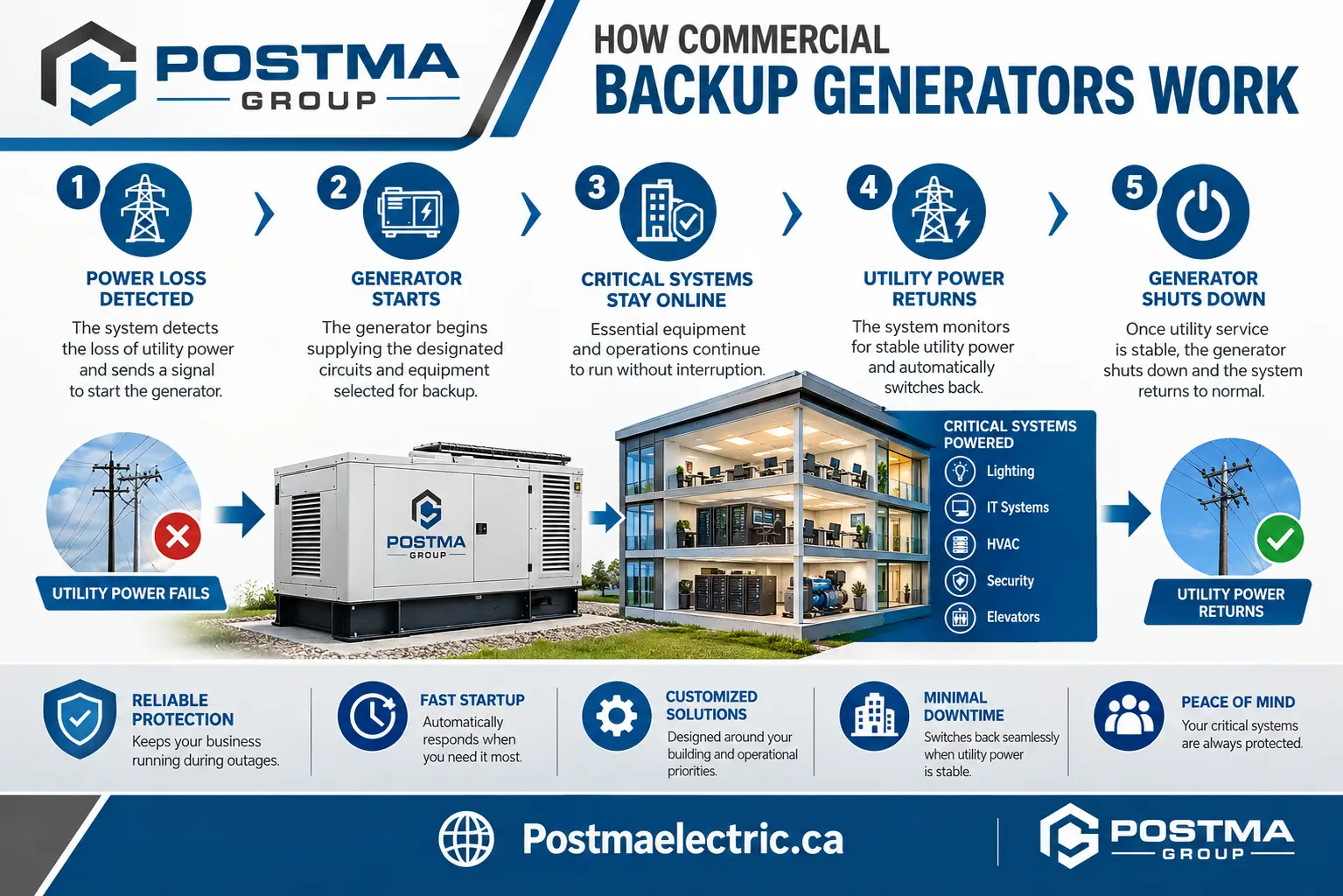
A commercial standby generator is permanently installed and wired into designated electrical systems — unlike a portable unit someone has to haul out and connect during an outage, a standby system is ready the moment utility power fails.
When an outage hits, the system detects the loss of power, the generator starts, and it begins supplying the circuits and equipment selected for backup. Once utility service returns and stabilizes, the system switches back and the generator shuts down.
A proper standby generator installation is planned around the building’s electrical system and operational priorities. The goal usually isn’t powering every outlet — it’s identifying what absolutely has to stay running and building the backup system around that.
Which Businesses Benefit Most
Almost any business feels an outage, but some face bigger consequences than others.
Healthcare facilities depend on power for medical equipment, lighting, refrigeration, and communications, so reliable emergency power systems are critical to safe operations. Manufacturing facilities can lose entire production runs when power disappears without warning — and restarting isn’t always as simple as flipping a switch. Retail businesses lose payment processing, lighting, refrigeration, and security the moment power drops, and every hour without electricity can mean lost revenue. Even office buildings, which may not look power-hungry, rely heavily on internet, computers, access control, and communications to keep people working.
Getting Generator Sizing Right
Generator sizing is one of the most important decisions in the whole process. Bigger isn’t automatically better, and guessing at size leads to unnecessary cost or a system that can’t handle the load.
We start by identifying what needs to stay running — lighting, heating, refrigeration, computers, servers, pumps, machinery, security, whatever the business depends on. Some equipment also draws far more power starting up than running — motors, compressors, pumps, and HVAC systems are common examples — and that has to be factored into the sizing too.
A qualified generator electrician runs the load calculations and assesses the existing electrical infrastructure, so the system gets built around what the business actually needs rather than a generic estimate.
Automatic Transfer Switches Explained
An automatic transfer switch (ATS) is a key part of most commercial backup systems. It monitors the normal power supply, signals the generator to start when it detects an outage, and safely transfers the designated load to generator power once it’s ready. When utility power returns, the process runs in reverse — the switch reconnects the building and lets the generator shut down.
For business owners, that automation is the real advantage. Outages don’t wait for business hours, and a properly designed standby system doesn’t depend on someone showing up to figure out what needs to be plugged in.
Generator Maintenance Best Practices
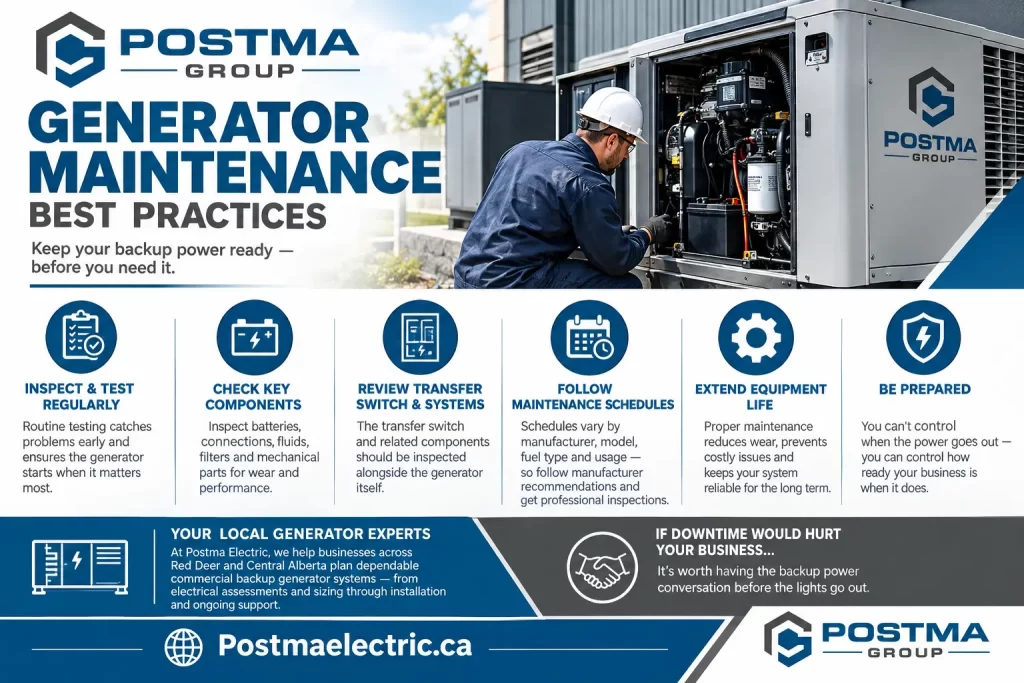 A generator spends most of its life idle, but it can’t be ignored. Batteries weaken, connections degrade, fluids and filters need attention, and mechanical parts need regular inspection — because the entire point of a standby generator is working reliably on the one day it’s actually needed.
Routine testing catches problems before a real outage does, and the transfer switch and related components should be inspected alongside the generator itself. Maintenance schedules vary by manufacturer, model, fuel type, and usage, so following the manufacturer’s recommendations and getting professional inspections done extends equipment life and reliability.
Backup power really comes down to preparedness. You can’t control when the power goes out — you can control how ready your business is when it does.
At Postma Electric, we help businesses across Red Deer and Central Alberta plan dependable commercial backup generator systems — from electrical assessments and sizing through installation and ongoing support. If downtime would hurt your business, it’s worth having the backup power conversation before the lights go out.
Frequently Asked Questions About Commercial Backup Generators
How quickly does a commercial standby generator provide power?
A properly designed automatic system detects the interruption and starts transferring designated loads to backup power right away. Exact timing depends on the generator, transfer equipment, and system design.
Does a commercial generator need to power the entire building?
Not necessarily. Many businesses back up only their most critical systems — a generator electrician can assess your loads and help decide what needs to stay running during an outage.
How do I know what size generator my business needs?
Sizing is based on the loads you want to support, including the higher starting demands of motors, pumps, compressors, and HVAC. A professional load assessment is the best way to nail down the right capacity.
What's the difference between a standby generator and a portable generator?
A standby generator is permanently installed and can run automatically with the right transfer equipment. Portable generators generally need manual setup, which makes them less practical for most commercial use.
Do commercial backup generators require regular maintenance?
Yes — routine maintenance and testing keep them dependable. Follow the manufacturer’s recommendations along with regular professional inspections.
Can Postma Electric install backup power for an existing commercial building?
Yes. We assess your building’s existing electrical infrastructure, backup power needs, and critical loads to put together the right solution for businesses across Red Deer and Central Alberta.